Treatments that work for one person might not work for you. It depends solely on your body, your symptoms and your needs. It might take a few goes at finding out what works for you, and don’t be disheartened if that changes down the line. With your hormones changing over time, finding what helps will need to evolve too.
Lifestyle choices
HRT (Hormone Replacement Therapy)
It is the replacement of oestrogen and progestogen that women lose or no longer produce due to the menopause.
HRT involves either taking both of these hormones (combined HRT) or just taking oestrogen (oestrogen-only HRT).
Depending on your circumstances and medical health, the HRT prescribed will be ‘tweaked’ depending on your hormone needs. However, if you have a previous history of cancer, blood clots, untreated high blood pressure, liver disease, or are pregnant, HRT may not be suitable to you (source here).
Take a look at the BMS TV video, where Kathy Abernethy, Director of Menopause Services, talks about HRT.
How do I take HRT?
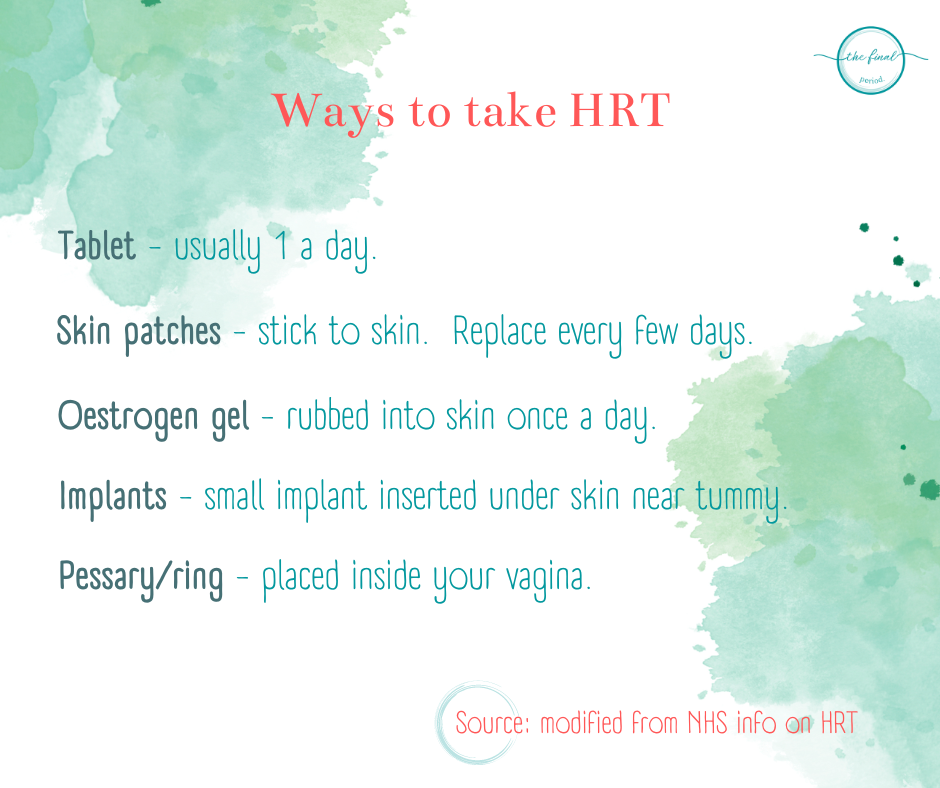
It can be given as tablets, patches, gels, vaginal creams, pessaries or rings. More on these explained below…
HRT – but what about breast cancer?
I imagine you read HRT, and without realising, thought of breast cancer? I did too…
The NHS website states “recent evidence says that the risks of HRT are small and are usually outweighed by the benefits”.
A further NHS website (source here) says “If you are under the age of 50 and take HRT, there is no extra risk of breast cancer. You still have the same risk of breast cancer as the rest of the population.
There is an increased risk for people over 50 who take combined HRT (oestrogen and progesterone taken together).”
What are the risks vs the benefits of HRT?
The ultimate benefit of taking HRT is to hopefully relieve the menopausal symptoms you were suffering. It can also help protect against weakening of the bones (oesteoporosis).
But there can be side effects when initially starting HRT. Oestrogen side effects can include cramps, feeling sick and bloating (see here for more details), whilst progesterone may cause breast tenderness, swelling, depression. The NHS advises to monitor such symptoms and obviously discuss with your GP if they do not settle.
The organisation, Women’s Health Concern has produced a comprehensive fact sheet on the risks and benefits of HRT. Ultimately, in the summary, it concludes by saying “For the majority of women who use HRT for the short-term treatment of symptoms of the menopause, the benefits of treatment are considered to outweigh the risks.” (click here for fact sheet).
How long should I take HRT?
This is by far a tricky one to answer. The NHS says:
“There’s no limit on how long you can take HRT, but talk to a GP about how long they recommend you take the treatment.
Most women stop taking it once their menopausal symptoms pass, which is usually after a few years.”
However, the NHS then advises the longer you take HRT can be linked to an increased risk of breast cancer.